For those of you who don’t know, St John’s College Durham is a curious mixture of a theological seminary for Anglican and Methodist ministers-in-training, and autonomous college as part of Durham University. It thus manages to combine elements both of secular and religious culture in interesting and eclectic ways. One the one hand you have people who are dedicating their lives to religious service; on the other hand you could have a passionately atheist undergraduate or postgraduate who is only interested in living the student life (I am still unaware of any passionately atheist trainee priests… but who knows?). I myself am a priest-in-training at St John’s, and thought I might share nine ways in which the college has prepared me for this Ugandan Adventure.
1) Climate
I live on D-Floor, in the Cranmer Hall wing of St John’s College. For those of you who don’t know, D-Floor is the hottest singular area upon the surface of Planet Earth. This is because the heat of A, B, and C Floors (which is considerable in itself) rises and conglomerates around my room. Therefore, though it be coldest winter, my window is generally open; and though it be hottest summer, the radiator - even though off - is still hot. This has prepared me well for the African climate: whilst the Ugandans around me my complain that ’Today is a hot day’, I say to them, ‘Nonsense! You should come to the North of England! That’s where you’ll find real heat!’
2) Food.
The food in St John’s College, though diverse, is bound by one substance: starch. Chips and pasta may be eaten on the same plate; vegetables are in short supply. Also, a strangely eclectic combination may be found on the same plate. Ever wanted chips and carrots? Well, come to St John’s! How about a cauliflower quiche? Why don’t you try it? Therefore, when I arrived in Uganda to discover that one could have pasta, rice, potatoes, sweet potato mash and bread on one singular plate, I did not think anything of it. Nor the idea of dipping potato chips into tea, nor the combination of peanut sauce and spinach (which is actually very delicious).
3) Facilities
In my tap in St John’s College, water comes in two types: boiling hot, and freezing cold. Much can be said for the first few days of my showering in Uganda. In both areas, the water from the tap is undrinkable, unless thoroughly boiled before use (though only in Uganda has it the potential to kill you… or was that St John’s?). In both St John’s and Uganda there is a surprising lack of WiFi, though if I’m honest, the developing nation of Uganda does beat the venerable college of St John’s on this account.
4) Culture
In St John’s College, everyone seems to know each other. You cannot walk down the corridor without saying ‘hello’ to someone. Little is different in Uganda; the possible difference is that in Uganda they may say hello, but they might not actually know you. Furthermore, there is a strange mix of cultures in both, in particular the blend of old and new. For instance, in Uganda everyone has the latest technology, though few people have access to decent water and food. St John’s is somewhat similar. In St John’s people dress up in funny clothes for special occasions (academic gowns). In Uganda they also do the same (tribal gowns). In St John’s, if you do anything at all, soon the whole college knows what has happened; the same may be applied in Uganda (hence why in both John’s and Uganda, one must be careful of what one says for fear of offending someone). In St John’s College, it is frequent for older undergraduates to attempt to seduce younger ones, called ‘Freshers’. They name this practice, ‘Sharking’. In Uganda, this is called arrange marriage.
5) Church
Both St John’s College and Uganda are passionately and openly Evangelical. Nevertheless, there are a surprising amount of Roman Catholics in both. St John’s College Communions tends to mix together a bizarre amalgam of disparate styles, including old hymns, modern worship, choir-based anthems, Taize and folk. In Uganda, they also like to combine old and new, brazenly and boldly not attempting to stylistically link them. Both in St John’s and Uganda the services go on for far too long, preachers go beyond their allotted time limit, and the liturgical structures of service in both places are, to say the least, eccentric.
6) Infrastructure
St John’s is arrived at through laboriously travelling across a difficult, narrow and bumpy road. Uganda, it seems, is no different, though this is due to potholes, rather than the city of Durham’s old cobbled streets. St John’s College is based on the arbitrary collusion of several terraced houses merged into one structure. In Uganda, the previous sentence may remain the same as long as the phrase ‘terraced houses’ is replaced by ‘tribes and provinces’. In both St John’s and Uganda there are far too many people crammed in one place for decent living space and, furthermore, both have rapidly expanding populations without adequate housing facilities. Finally, though facilities break down as quickly in both St John’s and Uganda, it tends to be the case that they are fixed with twice the speed in Uganda.
7) Politics
Both St John’s and Uganda have well-publicised democratic bodies which in reality hold little legislative power. In Uganda, this body is called ‘parliament’ - all real power is held by the President. In St John’s, this is called the John’s Common Room (JCR), which is the student representative body.
8) History
Both St John’s and Uganda are prone to outbreaks of civil war in unexpected places. In Uganda, this is a costly and nation-destroying process often between tribes and regions that must be ironed out with the passage of time. In St John’s, this is between the various sectors of the college, as the occasional long-term scrap is often to be found in the break-outs between undergraduates and trainee priests, undergraduates and postgraduates, postgraduates and trainee priests, undergraduates and administration, trainee priests and administration… (the list goes on).
9) Economy.
Both St John’s College and Uganda are nominally self-reliant. St John’s is proudly and happily an autonomous college as part of Durham University; Uganda has been proudly independent since the British Protectorate was withdrawn in the 60s. Nevertheless, in reality, both are heavily reliant on outsider’s donations: in Uganda, this is through aid and investment; in St John’s this is from college alumni and a bigger organisation called ‘Durham University’.
Showing posts with label potholes. Show all posts
Showing posts with label potholes. Show all posts
Friday, 27 September 2013

Monday, 16 September 2013
The Ugandan Adventure: Part V: A Tale of Two Weddings (Chapter Two: How I Almost Got Married)
Yesterday I referred you to a Ugandan church wedding in which I committed the unforgivable sin of taking numerous photos of the bride as she processed up the aisle. Today is quite different: a traditional Eteso wedding. Indeed, it is has given me a few ideas for my own wedding (which may have taken place a lot sooner than I had intended it…)
Wedding 2: Cows, goats, and mistaken identities
It took about three hours of travelling across pothole-ridden roads to arrive at a small village in the district of Palissa. Along the way, we merrily discussed my own status as ‘bachelor’; ‘What would your parents think if you brought home a black wife?’ I was asked. ‘I think they would have more questions over me bringing home a wife in the first place’ was my response. We all laughed. It was a witty little joke with witty little consequence.
Or so I thought. Or so I thought.
But first, the wedding. In an Eteso wedding, it is the groom who comes to the bride’s village, rather than the other way round (as in some other cultures I have been to, such as South India). The groom enters the village ‘square’ with his whole family (essentially most of his village); after cutting a ribbon, nearly a hundred people streamed through a little archway. What is more, there was a bubble machine. (I say this was a ‘traditional’ wedding: it had a traditionalist ritual and was next to a few mud-huts. Other than that, it had a DJ blasting out Ugandan Christian RnB Afro-pop - which is quite an interesting concept, to say the least). Nevertheless, it turns out the groom was late; accordingly, the Master of Ceremonies called for him to pay a fine to compensate the guests, which I think is an excellent idea. In Western weddings, brides so often turn up late that I think it is high time they gave financial compensation to us the poor and miserable waiting guests.
Once the groom was seated (hidden in the crowd of his family - we’ll see why in a bit), the bridal procession began. Sorry, did I say ‘procession’? I meant ‘processions’. You see, at an Eteso wedding, there is not one, nor two, but five bridal processions. And the bride only turns up in the last one. To explain: in the first procession, the bridesmaids (who effectively act as servants throughout the whole service) processed up, and knelt before the groom’s family. To the sound of Afro-pop, the groom’s aunts then got up and circled round the bridesmaids, looking for the bride (it felt akin to a marital version of pass-the-parcel). When they finally realised she was not there, aunts decided upon whether the bridesmaids themselves should be the bride. (I like this idea of having alternative brides in case the bride doesn’t turn up. Perhaps I shall include it in my wedding liturgy). Nevertheless, the gathering wholeheartedly said, ‘No’, after which the bridesmaids responded, ‘We shall go look for the bride, but we need money for transport!’ The groom proceeded to give them money.
This was all good fun. And it happened another four more times. And each time, the aunts would circle round, looking for the bride, and each time the group who had processed in would ask the group for money for transport. Considering that it was obvious that the bride was in one of the nearest huts, I thought this was a bit harsh on the groom, who had already paid a fine for being late. Nevertheless, in the words of Sean Connery in the film, The Man Who Would Be King, ‘Different cultures, different customs’. The second procession consisted of young girls from the village; the aunts thought this would not be a good match as it would be ‘defilement’ (i.e. paedophilia - never expected that mentioned at a wedding liturgy). After the young girls had left, the elderly ladies of the village processed in; once again, the same ritual followed.
After this, the bride’s distant cousins processed in. It was here that I almost got myself into a bout of trouble and, were it not for my cowardly nature and the good graces of the Lord, I may have been writing this as a married man now. You see, some of the bride’s cousins were exceptionally beautiful - one, in particular. I turned to my guide and translator from the village, and jokingly asked him,
‘Who is that girl there?’ said I. ‘She is very beautiful! Is she married?’
He laughed. ‘Ah, no, no, no, she is not.’
He was then silent for a while.
‘Would you like to talk to her afterwards?’ said he.
‘Well… maybe…’ said I, still naively flirtatious.
‘Ok…’ he said, more serious and sombre previously. ‘Shall I ask for her parents to be brought as well?’
I was confused. ‘But why should you bring her par-’ And then I realised. In the Ugandan cultures, if you are considering marrying a girl, you would meet her parents at the same time. ‘Er…’ said I, ‘probably not! We do marriage a little differently in England…and my parents would be somewhat upset…’ I added hastily. He seemed disappointed. For my thought, it was a very close call.
It was in the final procession with all the groups combined that the bride was present. Once found, she proceeded to search for the groom. And upon finding him, everyone started singing a song called, ‘Mr Handsome’, as he was presented to the gathering. For my future wife, if you happen to be reading this, know that this is the song I want played for me at my wedding.
The song I want sung at my wedding, as I enter the church [the song begins after one minute, though the music video is objectively the greatest ever made): http://www.youtube.com/watch?v=y2XZAc_TMk8
The groom subsequently discussed the dowry with his father-in-law (once again, unlike in other cultures, here the groom, not the bride, pays the dowry), which added up to a total of nine cows, nine goats and three million Ugandan shillings (just less than a thousand pounds). ‘Why nine cows and not eight?’ I hear the full multitude of you cry (for you are well acquainted with Eteso culture). Well, it because the groom had had a baby with the bride without the bride’s parents permission, and thus had to pay for the dishonour. Naughty boy.
Finally, the couple got engaged (yes, not married yet, but engaged). They presented each other with rings, and then sat down together. At that point, they were officially married, though not technically: that would happen later in the evening (if you get what I mean…). Presents were brought en masse to bride and groom (the usual: suitcases, chairs, fruit, lots and lots and lots of coca-cola). Finally, seven hours after it had begun, we all feasted.
And that, ladies and gentlemen (in an unusually long entry for my Ugandan blog) is an Eteso wedding. It is also the story of how I narrowly missed getting hitched myself. What does tomorrow’s entry have in stall? Let’s just say it involves dozens of people paying me homage whilst I sit upon a throne…
Wedding 2: Cows, goats, and mistaken identities
It took about three hours of travelling across pothole-ridden roads to arrive at a small village in the district of Palissa. Along the way, we merrily discussed my own status as ‘bachelor’; ‘What would your parents think if you brought home a black wife?’ I was asked. ‘I think they would have more questions over me bringing home a wife in the first place’ was my response. We all laughed. It was a witty little joke with witty little consequence.
Or so I thought. Or so I thought.
But first, the wedding. In an Eteso wedding, it is the groom who comes to the bride’s village, rather than the other way round (as in some other cultures I have been to, such as South India). The groom enters the village ‘square’ with his whole family (essentially most of his village); after cutting a ribbon, nearly a hundred people streamed through a little archway. What is more, there was a bubble machine. (I say this was a ‘traditional’ wedding: it had a traditionalist ritual and was next to a few mud-huts. Other than that, it had a DJ blasting out Ugandan Christian RnB Afro-pop - which is quite an interesting concept, to say the least). Nevertheless, it turns out the groom was late; accordingly, the Master of Ceremonies called for him to pay a fine to compensate the guests, which I think is an excellent idea. In Western weddings, brides so often turn up late that I think it is high time they gave financial compensation to us the poor and miserable waiting guests.
Once the groom was seated (hidden in the crowd of his family - we’ll see why in a bit), the bridal procession began. Sorry, did I say ‘procession’? I meant ‘processions’. You see, at an Eteso wedding, there is not one, nor two, but five bridal processions. And the bride only turns up in the last one. To explain: in the first procession, the bridesmaids (who effectively act as servants throughout the whole service) processed up, and knelt before the groom’s family. To the sound of Afro-pop, the groom’s aunts then got up and circled round the bridesmaids, looking for the bride (it felt akin to a marital version of pass-the-parcel). When they finally realised she was not there, aunts decided upon whether the bridesmaids themselves should be the bride. (I like this idea of having alternative brides in case the bride doesn’t turn up. Perhaps I shall include it in my wedding liturgy). Nevertheless, the gathering wholeheartedly said, ‘No’, after which the bridesmaids responded, ‘We shall go look for the bride, but we need money for transport!’ The groom proceeded to give them money.
 |
| Is the bride amongst these young girls? |
 |
| Is the bride amongst these elderly ladies? |
‘Who is that girl there?’ said I. ‘She is very beautiful! Is she married?’
He laughed. ‘Ah, no, no, no, she is not.’
He was then silent for a while.
 |
| In an alternative universe, this girl is now my wife. |
‘Well… maybe…’ said I, still naively flirtatious.
‘Ok…’ he said, more serious and sombre previously. ‘Shall I ask for her parents to be brought as well?’
I was confused. ‘But why should you bring her par-’ And then I realised. In the Ugandan cultures, if you are considering marrying a girl, you would meet her parents at the same time. ‘Er…’ said I, ‘probably not! We do marriage a little differently in England…and my parents would be somewhat upset…’ I added hastily. He seemed disappointed. For my thought, it was a very close call.
 |
| The bride is found |
The song I want sung at my wedding, as I enter the church [the song begins after one minute, though the music video is objectively the greatest ever made): http://www.youtube.com/watch?v=y2XZAc_TMk8
The groom subsequently discussed the dowry with his father-in-law (once again, unlike in other cultures, here the groom, not the bride, pays the dowry), which added up to a total of nine cows, nine goats and three million Ugandan shillings (just less than a thousand pounds). ‘Why nine cows and not eight?’ I hear the full multitude of you cry (for you are well acquainted with Eteso culture). Well, it because the groom had had a baby with the bride without the bride’s parents permission, and thus had to pay for the dishonour. Naughty boy.
 |
| The price of impatience: an extra cow for the dowry |
 |
| You're getting engaged? Congratulations! Have a lollipop |
And that, ladies and gentlemen (in an unusually long entry for my Ugandan blog) is an Eteso wedding. It is also the story of how I narrowly missed getting hitched myself. What does tomorrow’s entry have in stall? Let’s just say it involves dozens of people paying me homage whilst I sit upon a throne…
 |
| 'Different cultures, different customs' Coca Cola as a wedding gift |
Thursday, 12 September 2013
The Ugandan Adventure: Part II: Haiku and Potholes
It appears that several people enjoyed yesterday’s blog. This is both a good and a bad thing: a good thing in the sense that people are more likely to continue to read the blog; a bad thing in the sense that my most hard-core fans (particularly the Polish die-hards who I imagine have already begun quoting verbatim my posts, and have possibly begun to see how the new blog posts are a continuation - fulfilment even - of the short-lived blog of 2009) will inevitably be disappointed by the following. In a way, I feel like the Obama of blogging. Oblogma, maybe?
I arrived in Entebbe, Uganda last Monday after a long overnight flight stopping in Dubai. For much of the journey I was ferociously kicked in the face as I slept by the South African sleeping next to me. That this brute was only two years old and in no way conscious of what he was doing should in no way take away from the indignity suffered upon me. (The wonders of last-minute-booking.com).
After being picked up from the airport by my driver, Richard, I enjoyed the awesome Lake Victoria, before subsequently enjoying the hotel I was staying at (nicknamed ‘a view of a million dollars’). It was an excellent view, though I paid considerably less than a million dollars (more like thirty). For those eager beavers who have been following my every step, you may remember a picture of the mists enveloping the hills of Kampala. I was moved to write a haiku about it:
The hills are misty
On the hills of Kampala.
Misty are the hills
Admittedly it’s not the best poetry ever written, but as a matter of self-justification I might add that I had had only two hours sleep over the previous forty-eight hours due to the toddler monstrosity. That night I had little sleep due to the arrival of a tropical storm whose thunder and lightning shook awake even a weary traveller like myself. By the time the morning came, I was exhausted. And subsequently came my long, long, long journey to Soroti.
Before I came here, I imagined Uganda as a clay-reddish colour, similar to the hills of Zululand (or at least Zululand as presented in the film ‘Zulu’); I imagined lots of dust, where the occasional tree that emerged on the landscape was leafless and dead. With retrospect, I realise that I was imagining Botswana. Uganda, on the other hand, is astonishingly green, so much so that I (like the British imperialists of the 19th Century) cannot help but be reminded of England (even if it is a little hotter than Blighty…). Flowers bloom, trees are resplendent in their garments of leaves, the grass grows thick (the prose is somewhat purple…). The hills around Kampala (the misty ones, in case you forgot) were once considered as being so similar to what the Victorians imagined as ancient Israel that Uganda was genuinely suggested as a future home for European Jews instead of modern Israel.
It was this greenness that first astonished me on my long, long, long journey to Soroti. I even travelled through a rainforest (which the government is trying to cut down so as to build more sugarcane farms). The second astonishment was the roads. Richard, my driver, had warned me that Uganda roads were bad. Nevertheless, for the first three hours, I thought, ‘Nonsense!’ Even when the occasional pothole came up, I thought this was no worse than English country roads.
‘Richard, my dear friend’, said I, ‘I have seen much worse in the nation of India! This is a fine and veritable example of modern engineering I see before my eyes!’
Dear reader, how wrong I was. Soon, I was thrown up-and-down like the Greek economy, shook from left to right like the Labour Party, even at one point hitting my head on the window, like…well, someone hitting their head on something like a window. Potholes in almost every conceivable shape filled the road. Big ones, small ones, some as big as your head. Some were deep enough to lie down in. Most of the time, it was easier to drive on the dirt track on the side of the road than it was to dodge the frequent manifestations of tarmactic guerrilla warfare. Finally, at one point, we were driving simply on dirt track. Or at least, so I thought. For I realised that I was actually driving through one big pothole, with semblances of road still existing. I looked from pothole to road, and from road to pothole, and from pothole to road again; but already it was impossible to say which was which.
Though the distance between Kampala and Mbale is six times as long as from Mbale to Soroti, the journeying time for both was equal. This, ladies and gentlemen, is why road taxes are actually a good idea. My arrival in Soroti was, to put it mildly, a relief.
Thus ends today’s instalment. Tune in next time for further fun and excitement from the imaginatively named, ‘Ugandan Adventure’. Still yet to come: weddings, funerals, your narrator being overwhelmed by vicious mobs of five-year-old, your narrator being paid homage to as if he were a tribal chief, Germans, starch, goats and much, much more!
I arrived in Entebbe, Uganda last Monday after a long overnight flight stopping in Dubai. For much of the journey I was ferociously kicked in the face as I slept by the South African sleeping next to me. That this brute was only two years old and in no way conscious of what he was doing should in no way take away from the indignity suffered upon me. (The wonders of last-minute-booking.com).
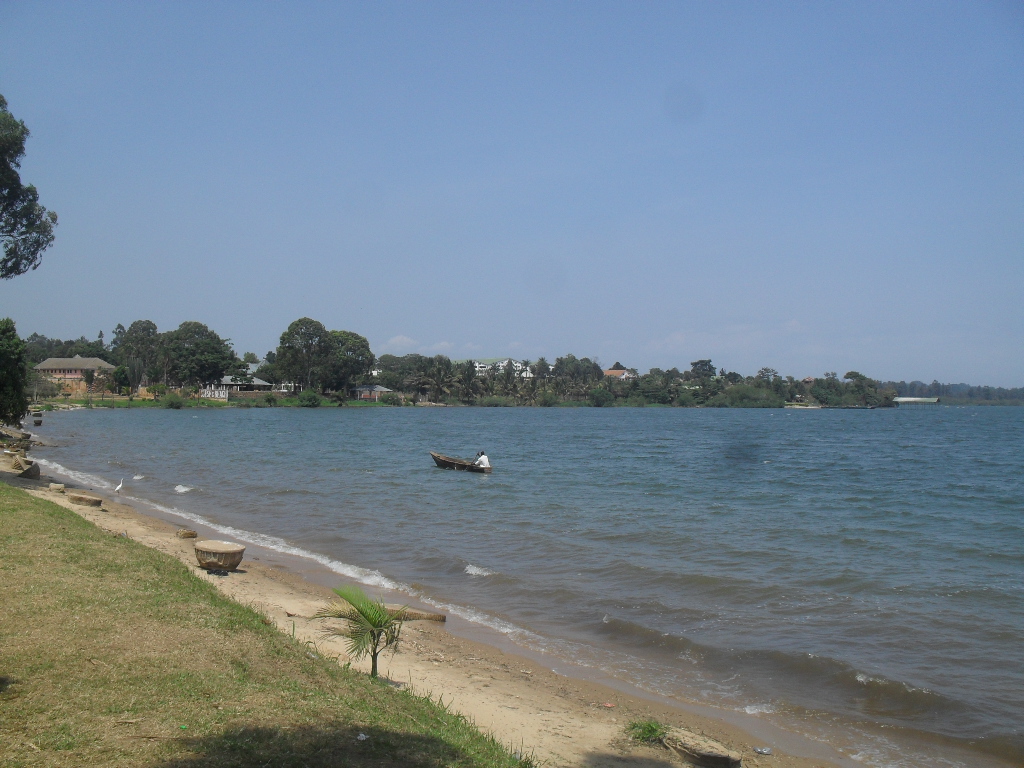 |
| Lake Victoria, or at least a very photogenic small part of it. |
The hills are misty
On the hills of Kampala.
Misty are the hills
Admittedly it’s not the best poetry ever written, but as a matter of self-justification I might add that I had had only two hours sleep over the previous forty-eight hours due to the toddler monstrosity. That night I had little sleep due to the arrival of a tropical storm whose thunder and lightning shook awake even a weary traveller like myself. By the time the morning came, I was exhausted. And subsequently came my long, long, long journey to Soroti.
 |
| It was once said by a great poet, 'The hills are misty/On the hills of Kampala'. Very true. |
Before I came here, I imagined Uganda as a clay-reddish colour, similar to the hills of Zululand (or at least Zululand as presented in the film ‘Zulu’); I imagined lots of dust, where the occasional tree that emerged on the landscape was leafless and dead. With retrospect, I realise that I was imagining Botswana. Uganda, on the other hand, is astonishingly green, so much so that I (like the British imperialists of the 19th Century) cannot help but be reminded of England (even if it is a little hotter than Blighty…). Flowers bloom, trees are resplendent in their garments of leaves, the grass grows thick (the prose is somewhat purple…). The hills around Kampala (the misty ones, in case you forgot) were once considered as being so similar to what the Victorians imagined as ancient Israel that Uganda was genuinely suggested as a future home for European Jews instead of modern Israel.
It was this greenness that first astonished me on my long, long, long journey to Soroti. I even travelled through a rainforest (which the government is trying to cut down so as to build more sugarcane farms). The second astonishment was the roads. Richard, my driver, had warned me that Uganda roads were bad. Nevertheless, for the first three hours, I thought, ‘Nonsense!’ Even when the occasional pothole came up, I thought this was no worse than English country roads.
‘Richard, my dear friend’, said I, ‘I have seen much worse in the nation of India! This is a fine and veritable example of modern engineering I see before my eyes!’
Dear reader, how wrong I was. Soon, I was thrown up-and-down like the Greek economy, shook from left to right like the Labour Party, even at one point hitting my head on the window, like…well, someone hitting their head on something like a window. Potholes in almost every conceivable shape filled the road. Big ones, small ones, some as big as your head. Some were deep enough to lie down in. Most of the time, it was easier to drive on the dirt track on the side of the road than it was to dodge the frequent manifestations of tarmactic guerrilla warfare. Finally, at one point, we were driving simply on dirt track. Or at least, so I thought. For I realised that I was actually driving through one big pothole, with semblances of road still existing. I looked from pothole to road, and from road to pothole, and from pothole to road again; but already it was impossible to say which was which.
 |
| Technically, this is not a dirt track, but an elongated pothole. |
Though the distance between Kampala and Mbale is six times as long as from Mbale to Soroti, the journeying time for both was equal. This, ladies and gentlemen, is why road taxes are actually a good idea. My arrival in Soroti was, to put it mildly, a relief.
Thus ends today’s instalment. Tune in next time for further fun and excitement from the imaginatively named, ‘Ugandan Adventure’. Still yet to come: weddings, funerals, your narrator being overwhelmed by vicious mobs of five-year-old, your narrator being paid homage to as if he were a tribal chief, Germans, starch, goats and much, much more!
Subscribe to:
Posts (Atom)