This Ugandan Adventure has brought a few surprises, not least the fact that I am in Uganda, as originally I was supposed to be in Nigeria. Although a few friends might not put it past me, I did not happen to get on the wrong plane at Birmingham Airport and, finding myself in the wrong country, hastily organised a new placement. No, instead, Nigeria proved itself to be too dangerous for the time being; plus, the Anglican Church of Nigeria was not currently happy with the Church of England, and so decided to cut off links with its English friends. So, instead, through chance, luck, or I as a Christian may put it, providential grace, I found myself in the flatlands of Soroti.
One surprise happened a little while ago. I was happily walking the grounds around the Guest House (commonly called ‘The White House’ by the locals, which I feel gives me a Presidential air that resonates with my experience of being given homage…), when I noticed my neighbour’s pigs happily grazing the ground. ‘Ah!’, thought I, ‘the rustic air! The simple life!’ Seeing as he was the Prison Chaplain, my neighbour’s rural idyll gave me notions of how I could be in my own ministry a few years hence. Suddenly, though, one of the pigs looked up at me. Whether it was from murderous instinct or fear of my overwhelming demeanour, the pig made a charge at me. ‘Ha!’ thought I, ‘You shall not touch me! Your leash, you see, binds you to your ground, whilst I am free to roam and wander!’ Unfortunately, however, murder/fear proved the better of the leash, and the pig pulled it up from its sticking place. But rather than attack, the pig rushed passed me, towards the road. I dashed after it, clutching its straggling lead before a motorbike came whizzing past. To be sure, the pig was strong. I had to drag it at first, before it finally attuned itself to me. And within a few moments, there I was, walking a pig down the road as if it were a dog. I finally managed to get hold of the Prison Chaplain, and together we tied the leash into its sticking place a little firmer, this time.
Another surprise happened this Sunday. After a very bad night’s sleep, I had to awake at 5am so as to arrive at the Cathedral in Soroti for its 6am Holy Communion Service. I had been told that I would have to arrive early, as it would be difficult to get a seat. ‘A slight exaggeration, methinks’ thought I, confident that no one in their right mind would want to be up so early, especially considering that most would have to walk a few hours to get to the Cathedral. ‘A few dedicated souls shall be there, and we shall sleepily share in the sacrament of Eucharist together, wearily sharing the peace, and quietly singing.’
I was wrong. Revd David, the Vicar of the Cathedral, picked me up on his motorbike at 5.50am. It’s the first time I have happened to travel to church via motorbike, though it was made very special by witnessing a ravishingly red-orange-purple sunrise. As we arrived at the Cathedral, the sun was still breaking its red streams through the windows. Inside, however, it was already bustling and crowded, distinguishing it from the sleepy serenity in the outside natural world. A seat had been reserved for me, though I noticed I would be having ushers sitting all around. Considering that the Cathedral can comfortably seat two-three thousand, the fact that people were standing in the aisles, at the sides and clogging the doorways is astonishing. Furthermore, that people had walked miles to get here in the early morning darkness puts shame to those (including occasionally myself) who in the UK complain that a 10am service is too early.
The service, furthermore, was lively and exciting. Even as people received the Eucharist, rather than English reflective (quasi-mournful) style, the music was dominated by energetic and joyful hymns of praise. I rather like the idea: instead of the manifestation of eternal mystery, it evokes an image of the raucous eschatological banquet. When I was asked to give the reading (Romans 12) I even got applause! The subsequent sermon was excellent. Revd Sam, who co-ordinates the diocesan Educational Policy, preached on Paul’s command to ‘be transformed by the renewing of your minds’, emphasising that school education must inculcate values rather than simply imparting knowledge. ‘All education without God produces is clever devils’ he wittily said (debate to your heart’s content…). When he directly criticised the government’s nonchalant approach towards the striking teachers, the massive congregation burst out in applause and shouts of agreement.
As it happens, I was sitting next to a man who I later discovered to be the Ugandan Minister of Government for disaster relief, Musa Ecweru. He himself got up to speak toward the end of the service, an heartily agreed with Revd Sam’s sermon, and distanced himself from his governmental colleagues. (Ah… politics…). Afterwards, I got chatting to him. Which produced another surprise: who would have thought, when I was a simple musical composer before I had had a calling to be an Anglican priest, that in a few years time I would be discussing economic policy and swapping contact details at 9am in the morning with a Ugandan Minister, in the heart of Africa? Life (or providential grace…) produces some fascinating surprises.
Showing posts with label Soroti. Show all posts
Showing posts with label Soroti. Show all posts
Tuesday, 24 September 2013

Friday, 20 September 2013
The Ugandan Adventures: Part VIII: Mzungu Heroically Beholds the Jaws of Death
When I went to bed, I had a slight itch upon my midriff and in my inner biceps. I thought, ‘Insect bite, probably’, and put some cream on it. During the night, the itching got worse, maddeningly so. Then morning came: my waist, arms and inner thighs were covered with a lumpy, blotchy rash. And the itching was even worse. I showed George my housekeeper, and he said that we would go to the medical centre when it opened.
In the meantime, I was fairly Stoically endowed. Whatever it was, I could cope. Then, out of curiosity, I thought, ‘Why don’t I check that most reliable source of information, the internet, to find out what this rash may be?’ So, after initially attempting to check the NHS symptoms website - only to discover that they only address British diseases… bigoted nationalists… - I typed in the immortal words, ‘Uganda skin rash’. After a few minutes browsing, I discovered that I had Ebola, a HIV rash, German measles, meningitis, and skin parasites (that would leave me dead in about eight hours). As one very helpful website put it: ‘Go the nearest Westernised hospital; there is a good chance that if you don’t hurry, you may be dead or paralysed within the next twenty four hours’. So… Ebola, measles, death, meningitis, death, death, skin parasites, death, Death, DEATH!
Thanks internet.
George, my housekeeper was rather optimistically inclined considering the circumstances (‘The doctor give you tablets… you be fine…’). As we walked to the medical centre, I showed the best of English stoicism: ‘Best keep your head up high, eh George? Whatever will be, will be, eh George? Eh? What oh! Eh, George? Nothing to worry about, eh George? …eh?…George…?’ Inwardly, however, I was beginning to make the arrangements for my dead body’s return to Blighty. Robert Browning’s poem, ‘Oh, to be in England’ came to mind, as did Rupert Brooke’s,
‘If I should die, think only this of me:
That there’s some corner of a foreign field
That is for ever England.’
But as I was preparing for Brooke’s ‘English heaven’ (considering I’m a Welshman, this should cause some pause of reflection…), and fearing my long, painful death in a mud hut in Soroti or a hospital bed in Kampala, I arrived at the medical centre. I was not, I must admit, filled with the greatest of confidence. Although it was clean, it was very dark, with dust everywhere, with cracks in the walls and floors, and an old rickety wooden desk and chairs. As I waited for the pharmacist, I read a big poster all about the symptoms of Ebola:
Rash: check.
Headache: do I have a headache? I think I do, yes, yes, I have a headache! I’m certain of it!
Dizziness: now I come to think of it, I am feeling a little dizzy…
Bloodshot eyes: I have no mirror, but my eyes do sting a little…
The list goes on, and by the end, I was certain of my impending death. Then the pharmacist arrived. He looked at my rash, asked if I wanted an injection (the UK government information on Uganda screamed at me from the deeper recesses of my subconscious: DO NOT HAVE INJECTIONS OUTSIDE OF KAMPALA), to which I politely refused. He then gave me tablets, including pirotin for the itching, and told me it was probably a allergic reaction. I subsequently sent a Facebook message to my Auntie Jenn, who calmly reminded me of the amount of medicine I had been taking in order to survive Uganda. Allergic reactions are somewhat common…
And, once the tablets were taken, the itching began to stop, and the lumpy rash began to dissipate. Despite being somewhat drowsy the rest of the day because of taking my pirotin tablet, I was healthy. Nevertheless, this very morning, in the middle of a conversation over breakfast with a Pentecostal Pastor staying at the Guest House, I accidentally took two of the very strong pirotin tablets instead of the recommended one. And just as he was telling me about the institutional structure of Ugandan Pentecostalism in relation to other Ugandan NGOs, I fell fast asleep to the extent that I was afterwards told I was snoring within a few seconds. At which point, George woke me up and helped me into my bed (realising what had happened). For two subsequent hours I slept.
I’m sure the Pentecostal Pastor will now think twice now before deciding to talk about institutional structures over breakfast.
I was one of the lucky ones. The tablets I took cost me 4000 Ugandan shillings (about £1, or $1.30 roundabouts). It would stop me scratching, and thus mean that I was unlikely to be infected by anything worse. I thought it was remarkably cheap. By Ugandan standards, however, it is not. For many, that might have been a week’s pay. For others, it might have been a month’s. Let me give you an example: in one of the village churches I had visited, the gathered weekly tithes and offerings of a congregation of over three hundred would be about 1000 shillings (about 25p, or 40c). This was not the type of giving you expect from a Church of England country parish where elderly ladies may give 25p because when they were told to give as much when they were little girls (currency revaluation and fifty years of inflation not withstanding). Instead, this is all these people can afford to give. The Ugandan teachers are currently on strike in that they are paid so little that they cannot afford to send their children to school (irony not withstanding). In that context, my 4000 shillings is a fortune. Or let’s put it another way: if my pirotin and prednisolone costs so much to the average Ugandan, how should my dear Ugandan friend cope, whose wife has got severe cancer with basic treatment costing £1,500, and whose daughter has got typhoid with treatment costing a further £200?
Sorry to get political, but privatising medicine can only work if the average citizen can pay for it. Otherwise, you get poorly invested hospitals and sick citizens, which, once considered, is a moebius strip of a problem.
In the meantime, I was fairly Stoically endowed. Whatever it was, I could cope. Then, out of curiosity, I thought, ‘Why don’t I check that most reliable source of information, the internet, to find out what this rash may be?’ So, after initially attempting to check the NHS symptoms website - only to discover that they only address British diseases… bigoted nationalists… - I typed in the immortal words, ‘Uganda skin rash’. After a few minutes browsing, I discovered that I had Ebola, a HIV rash, German measles, meningitis, and skin parasites (that would leave me dead in about eight hours). As one very helpful website put it: ‘Go the nearest Westernised hospital; there is a good chance that if you don’t hurry, you may be dead or paralysed within the next twenty four hours’. So… Ebola, measles, death, meningitis, death, death, skin parasites, death, Death, DEATH!
Thanks internet.
George, my housekeeper was rather optimistically inclined considering the circumstances (‘The doctor give you tablets… you be fine…’). As we walked to the medical centre, I showed the best of English stoicism: ‘Best keep your head up high, eh George? Whatever will be, will be, eh George? Eh? What oh! Eh, George? Nothing to worry about, eh George? …eh?…George…?’ Inwardly, however, I was beginning to make the arrangements for my dead body’s return to Blighty. Robert Browning’s poem, ‘Oh, to be in England’ came to mind, as did Rupert Brooke’s,
‘If I should die, think only this of me:
That there’s some corner of a foreign field
That is for ever England.’
But as I was preparing for Brooke’s ‘English heaven’ (considering I’m a Welshman, this should cause some pause of reflection…), and fearing my long, painful death in a mud hut in Soroti or a hospital bed in Kampala, I arrived at the medical centre. I was not, I must admit, filled with the greatest of confidence. Although it was clean, it was very dark, with dust everywhere, with cracks in the walls and floors, and an old rickety wooden desk and chairs. As I waited for the pharmacist, I read a big poster all about the symptoms of Ebola:
Rash: check.
Headache: do I have a headache? I think I do, yes, yes, I have a headache! I’m certain of it!
Dizziness: now I come to think of it, I am feeling a little dizzy…
Bloodshot eyes: I have no mirror, but my eyes do sting a little…
The list goes on, and by the end, I was certain of my impending death. Then the pharmacist arrived. He looked at my rash, asked if I wanted an injection (the UK government information on Uganda screamed at me from the deeper recesses of my subconscious: DO NOT HAVE INJECTIONS OUTSIDE OF KAMPALA), to which I politely refused. He then gave me tablets, including pirotin for the itching, and told me it was probably a allergic reaction. I subsequently sent a Facebook message to my Auntie Jenn, who calmly reminded me of the amount of medicine I had been taking in order to survive Uganda. Allergic reactions are somewhat common…
 |
| Hero of the day: the optimistically minded George |
 |
| My medicine, in the packaging given to me at the pharmacist |
I’m sure the Pentecostal Pastor will now think twice now before deciding to talk about institutional structures over breakfast.
I was one of the lucky ones. The tablets I took cost me 4000 Ugandan shillings (about £1, or $1.30 roundabouts). It would stop me scratching, and thus mean that I was unlikely to be infected by anything worse. I thought it was remarkably cheap. By Ugandan standards, however, it is not. For many, that might have been a week’s pay. For others, it might have been a month’s. Let me give you an example: in one of the village churches I had visited, the gathered weekly tithes and offerings of a congregation of over three hundred would be about 1000 shillings (about 25p, or 40c). This was not the type of giving you expect from a Church of England country parish where elderly ladies may give 25p because when they were told to give as much when they were little girls (currency revaluation and fifty years of inflation not withstanding). Instead, this is all these people can afford to give. The Ugandan teachers are currently on strike in that they are paid so little that they cannot afford to send their children to school (irony not withstanding). In that context, my 4000 shillings is a fortune. Or let’s put it another way: if my pirotin and prednisolone costs so much to the average Ugandan, how should my dear Ugandan friend cope, whose wife has got severe cancer with basic treatment costing £1,500, and whose daughter has got typhoid with treatment costing a further £200?
Sorry to get political, but privatising medicine can only work if the average citizen can pay for it. Otherwise, you get poorly invested hospitals and sick citizens, which, once considered, is a moebius strip of a problem.
Wednesday, 18 September 2013
The Ugandan Adventure: Part VI: Meeting Nicholas Cage and Receiving Homage
One of the stranger things to happen to me of late was a discovery of a time portal, through which I (and a few friends) could travel to any point in history. Furthermore, it allowed us to communicate across the eras. One friend travelled through to the 19th Century, at which point he walked into a shop to buy a sandwich, only to discover that the menu did not have any prices on. When the sandwich arrived, it lacked any bread (it was, essentially, a pile of chicken pieces) and cost £20. I, on the other hand, went to Ancient Rome where I encountered the Hollywood actor Nicholas Cage, who was a traffic warden. Furthermore, he was also a traffic warden in the 19th Century, and the present day. He had gone for a career change to become the Doctor Who of road traffic.
‘I knew this would happen’ I hear you say. ‘Your great learning has driven you insane, Josh’ the distant voices cry. No, as it happens. This was yet another malaria-tablet-induced dream. Despite what the naysayer may say, I am completely sane, or at least my good friend the King of Assyria tells me so.
To move onto more sensible climbs, I will tell you about religion. Ugandan style. You see, when I first arrived in Uganda (at my hotel with a view of a million dollars in Kampala), I noticed there was a picture on the wall. Who was it of? Not the Pope, nor the Ugandan President, but rather the Archbishop of the Anglican Church of Uganda. For those who are used to the nice, cosy image of Anglicanism in the Church of England (where it would be rather unusual to find pictures of our dear Archbishop Justin Welby hanging around in the leading hotels in the country), Anglicanism in Uganda is a different kettle of fish. For one thing it is thriving. And I don’t mean ‘The-church-has-a-nice-new-young-couple’ type of thriving, but rather, ‘the-church-has-a-nice-new-large-village-of-two-thousand’ type of thriving. Although Roman Catholicism is still the largest denomination, Anglicanism is not too far behind.
I realised this when I went to a village in a Kuman region (a district near Soroti) for a Confirmation Service (for children and young people - and a few older ones as well - who are being confirmed into the Anglican denomination). Not only was the whole village present for the Confirmation (the church was packed to overflowing - it would make many a British ‘mega-church’ blush), but I also discovered that the local school was Anglican, its political representatives were Anglican, and I think even the animals were the ‘spiritual-but-not-religious’ type of Anglican as well. This is not the type of liberal incense and candles Anglicanism that you would find in the American Episcopalian Church, or the quiet little Matins Service in an English Country Parish. Instead, this is full-blooded African Anglicanism: a service can easily last five hours (with a two hour sermon), with a strange combination of a translated version of Cranmer’s Book of Common Prayer and hypnotic traditional African music (repetitive, with call-and-response, dominated by voices, drums and African harps). Even though the bishop was garbed like his European Medieval predecessors, his faith is full-throttle Conservative Evangelicalism. He preaches with an astonishing passion and energy and without notes. Sometimes he is so loud, the microphones start screeching. Once again, in contrast to much Western Christianity, his is a typically African sermon of death, judgment, and hope in Jesus Christ. A two hour sermon is quite usual for him.
Indeed, with the village churches packed, the Cathedral in Soroti packed (easily over a thousand in each of its four Sunday services), and a total of 276 schools in the Soroti district alone, it appears that the author of the book ‘The New Christendom’, Philip Jenkins, is right: Christendom is no longer found in Europe or North America, but in Africa and South America (and increasingly in China and the Far East). Whilst religion in Europe has taken three centuries of battering by an increasingly confident secularism, introducing public secularism into somewhere like Uganda would probably cause the country (or at least the educational system) to collapse. The ancient tribal religions have mostly fled into the shadows of the country; Islam is a minority. Secularism is nowhere to be found. Christianity is culturally, socially and politically dominant.
I got a taste of how much things have changed. To a certain extent figures like bishops have taken on the traditional role of the tribal elders. Roles can take a long time to change in cultures; the gestures may remain the same even if the type of person in a social role has changed. In this village in the Kuman region, the whole church gathered into a line to shake the bishop’s hand. But where this differed from a Church of England model is that the bishop stayed seated at the front, and the church processed to greet him there. And when they did shake his hand, they would kneel before him, as if he were a tribal elder: not just the women - as is the custom of the Kumi - but the men as well. I also was greeted thus: people would walk up to my chair and kneel before me as they shook my hand. In a sense, I was paid homage.
This is a pleasant experience to have, despite my egalitarian principles, and I have decided to introduce this gesture as soon as I head back to the UK.
Tune in tomorrow to see more fun, sun and adventures in Penduck of Life’s Ugandan Adventures. Tomorrow we’ll be encountering the children of Uganda, and how Ugandan six-year-olds are better than me at football, and have an interested habit of staring at me… endlessly…
‘I knew this would happen’ I hear you say. ‘Your great learning has driven you insane, Josh’ the distant voices cry. No, as it happens. This was yet another malaria-tablet-induced dream. Despite what the naysayer may say, I am completely sane, or at least my good friend the King of Assyria tells me so.
To move onto more sensible climbs, I will tell you about religion. Ugandan style. You see, when I first arrived in Uganda (at my hotel with a view of a million dollars in Kampala), I noticed there was a picture on the wall. Who was it of? Not the Pope, nor the Ugandan President, but rather the Archbishop of the Anglican Church of Uganda. For those who are used to the nice, cosy image of Anglicanism in the Church of England (where it would be rather unusual to find pictures of our dear Archbishop Justin Welby hanging around in the leading hotels in the country), Anglicanism in Uganda is a different kettle of fish. For one thing it is thriving. And I don’t mean ‘The-church-has-a-nice-new-young-couple’ type of thriving, but rather, ‘the-church-has-a-nice-new-large-village-of-two-thousand’ type of thriving. Although Roman Catholicism is still the largest denomination, Anglicanism is not too far behind.
I realised this when I went to a village in a Kuman region (a district near Soroti) for a Confirmation Service (for children and young people - and a few older ones as well - who are being confirmed into the Anglican denomination). Not only was the whole village present for the Confirmation (the church was packed to overflowing - it would make many a British ‘mega-church’ blush), but I also discovered that the local school was Anglican, its political representatives were Anglican, and I think even the animals were the ‘spiritual-but-not-religious’ type of Anglican as well. This is not the type of liberal incense and candles Anglicanism that you would find in the American Episcopalian Church, or the quiet little Matins Service in an English Country Parish. Instead, this is full-blooded African Anglicanism: a service can easily last five hours (with a two hour sermon), with a strange combination of a translated version of Cranmer’s Book of Common Prayer and hypnotic traditional African music (repetitive, with call-and-response, dominated by voices, drums and African harps). Even though the bishop was garbed like his European Medieval predecessors, his faith is full-throttle Conservative Evangelicalism. He preaches with an astonishing passion and energy and without notes. Sometimes he is so loud, the microphones start screeching. Once again, in contrast to much Western Christianity, his is a typically African sermon of death, judgment, and hope in Jesus Christ. A two hour sermon is quite usual for him.
 |
| The whole village processes to church |
Indeed, with the village churches packed, the Cathedral in Soroti packed (easily over a thousand in each of its four Sunday services), and a total of 276 schools in the Soroti district alone, it appears that the author of the book ‘The New Christendom’, Philip Jenkins, is right: Christendom is no longer found in Europe or North America, but in Africa and South America (and increasingly in China and the Far East). Whilst religion in Europe has taken three centuries of battering by an increasingly confident secularism, introducing public secularism into somewhere like Uganda would probably cause the country (or at least the educational system) to collapse. The ancient tribal religions have mostly fled into the shadows of the country; Islam is a minority. Secularism is nowhere to be found. Christianity is culturally, socially and politically dominant.
I got a taste of how much things have changed. To a certain extent figures like bishops have taken on the traditional role of the tribal elders. Roles can take a long time to change in cultures; the gestures may remain the same even if the type of person in a social role has changed. In this village in the Kuman region, the whole church gathered into a line to shake the bishop’s hand. But where this differed from a Church of England model is that the bishop stayed seated at the front, and the church processed to greet him there. And when they did shake his hand, they would kneel before him, as if he were a tribal elder: not just the women - as is the custom of the Kumi - but the men as well. I also was greeted thus: people would walk up to my chair and kneel before me as they shook my hand. In a sense, I was paid homage.
This is a pleasant experience to have, despite my egalitarian principles, and I have decided to introduce this gesture as soon as I head back to the UK.
Tune in tomorrow to see more fun, sun and adventures in Penduck of Life’s Ugandan Adventures. Tomorrow we’ll be encountering the children of Uganda, and how Ugandan six-year-olds are better than me at football, and have an interested habit of staring at me… endlessly…
Sunday, 15 September 2013
The Ugandan Adventure: Part IV: A Tale of Two Weddings (Chapter One: The Day I Brought Shame Upon Myself)
It appears that across the Christian world (which includes post-Christian to those who are sensitive about these things…) that Saturday is still the preferred day of choice for weddings in that, for my last two Saturdays I have been in attendance for festivities. Last week was a church wedding; this week, a traditional Eteso ceremony. In which case, for your entertainment, amusement and interest, I shall regale you with the finer details.
Wedding 1: When Thomas Cranmer met Afro-Pop Wagner
Sometimes, cultural accommodation can take a step too far. One often finds this among those who have spent far too long in an alien culture: upon returning to their mother culture, they have feelings of shame, guilt and regret over some of the friends they may have made, spouses they may have taken, or activities they may have participated in. My dear readers, I now share this shame. ‘Why?’, you may ask. ‘What possible, horrific thing could you have done that makes you feel in such a way?’ Others may ask, ‘Have you taken on a Ugandan wife? Have you taken part in some ancient sacrificial ritual?’ No, neither of these. But, in order to justify myself in what I have done, the story needs to be told.
I had been invited to a wedding in St Peter’s Cathedral, Soroti, by Bishop George. Whilst waiting for the service to start, I happened to meet two German girls who are here in Soroti for a year doing charity work with Soroti Diocese (when you encounter fellow Europeans in Africa, you always have the urge to talk to them). Furthermore, I was being given honoured greetings by everyone (a sure pull towards the failings of pride). And then, everyone told me, ‘Remember to take pictures!’ A certain rebellious spirit arose in me - ‘unlike in churches back home’, thought I, ‘pictures shall be taken of this wedding! And during the service as well!’ And so I did: whence the groom processed up the aisle (for yes, in Uganda both bride and groom get processions!), I took photographs from the side of the church. Yes reader, I was not an official photographer, but I still snapped away. I beheld the simple Afro-pop melody with the older ladies dancing around the groom as he processed, shrieking their pulsating falsetto (which is a sign of joy), and I happily took more and more pictures.
Perhaps I was trying to impress the German girls (‘Look at me! I can be incultural too!’); perhaps it was the rising heat that caused evil thoughts to emerge in the chambers of my mind; perhaps it was a sheer sense of fallen rebelliousness that drove my vaulting ambitions. But oh! I went too far! The ushers said to me that when the bride comes I was allowed to stand in front of the procession. I could process in front of the bride. And so I, callous and unthinking of my dear ones back at home, followed their advice. Whence the bride processed up the aisle - to the sound of an Afro-Pop version of Wagner’s ‘Here comes the bride’ - I gradually walked backwards ahead of her, taking pictures and even a video. Yes, I broke that ancient unwritten English law: I blocked people’s view of the bride. I took their attention. In doing so, I became an Other to myself. I now realise the wretch that I am.
The rest of the service was a curious mixture of Thomas Cranmer’s Book of Common Prayer (1662 version), translated into Eteso, with Afro-pop hymns (and a long, long, long sermon from Bishop George: he sure can preach!). One of my favourite points of the wedding was hearing a young lady reading the scriptures in a 1950s Church of England style, but in a strong African accent. At the point at which each of the couple said, ‘I do’, the whole of the congregation would cheer (including whistles, vuvuzelas, horns, and pulsating falsetto shrieks). Everyone had a tendency to wave flags over the couple as well. And after only two hours, it was over.
This was in mighty contrast to the second, traditional Eteso wedding…
But that, I’m afraid, will have to wait until tomorrow. Be sure that it contains many elements I now want included in my own wedding (including a song sung about me plus the presentation of alternative brides) and a few things I don’t want (myself having to pay a dowry plus the paying of fines if I am late).
Wedding 1: When Thomas Cranmer met Afro-Pop Wagner
 |
| The Procession of the Groom |
 |
| The beginnings of the bridal procession |
 |
| Yes, dear reader, I processed in front of the bride... |
The rest of the service was a curious mixture of Thomas Cranmer’s Book of Common Prayer (1662 version), translated into Eteso, with Afro-pop hymns (and a long, long, long sermon from Bishop George: he sure can preach!). One of my favourite points of the wedding was hearing a young lady reading the scriptures in a 1950s Church of England style, but in a strong African accent. At the point at which each of the couple said, ‘I do’, the whole of the congregation would cheer (including whistles, vuvuzelas, horns, and pulsating falsetto shrieks). Everyone had a tendency to wave flags over the couple as well. And after only two hours, it was over.
This was in mighty contrast to the second, traditional Eteso wedding…
But that, I’m afraid, will have to wait until tomorrow. Be sure that it contains many elements I now want included in my own wedding (including a song sung about me plus the presentation of alternative brides) and a few things I don’t want (myself having to pay a dowry plus the paying of fines if I am late).
Friday, 13 September 2013
The Ugandan Adventure, Part III: The Ten Hour Funeral
Before I arrived in Uganda, my friend Lucy called me to say that a retired Ugandan bishop had died of a snake bite in his own village. Papa Bishop Geresom Ilukor (Bishops are affectionately named ‘Papa’ in Uganda) was a major figure in both the Ugandan church and Ugandan politics. After his retirement (he was bishop of Soroti from 1976-2000) he advised many minor politicians, and was much respected (even by the Ugandan President). I didn’t realise just how important of a figure he was until I arrived in Soroti.
http://chimpreports.com/index.php/special-reports/crime-investigation/12560-snake-bite-kills-teso-bishop-ilukor.html - a link to a Ugandan newspaper. They've got a picture about 'Papa' Bishop Gereson, with some information
After my long, long, long journey through potholed roads, I rested for a few days in the Guest House in Soroti, before being invited by Bishop George of Soroti Diocese to attend the funeral. And so, on Friday 6th, I awoke early to drive to Kumi where the funeral was being held. Kumi is a smallish town (a little smaller than Soroti), where the hotel toilet has a sign with an unfortunate typo: ‘Please remember to flash after toilet use’. Nevertheless, for a town so small, the turnout to the burial was astonishing. They tell me there were enough chairs for 12,000 people (we all sat in a large square with the bishop’s coffin in the centre). But so many people turned up that they estimated nearly 20,000 present. Amongst these arrivals were bishops, pastors, ministers of government, leaders of universities, business leaders, the chairman of the ruling National Resistance Party, the Prime Minister, the President’s personal representative, and many, many more. After an initial bit of liturgy and song at the beginning of the funeral (three choirs got up to sing traditional African farewells), all of these figures began to give their eulogies.
In the Church of England, we usually have one or eulogies, in total lasting ten minutes. In Uganda they have… well, I lost count. One eulogy easily lasted an hour. Considering most of it was in Kuman or Etoso, or in very thick Ugandan-English accent, I couldn’t understand most of it. And so I sat and waited. The service started at 9.00am with the arrival of the body. By 10.30am the liturgy had finished, and the eulogies began. Nearly five hours later, at 3.10pm, the Archbishop of Uganda stood up to preach. In the midst of the sweltering sun (thankfully we had canopies above us), I heard perhaps fifty or more eulogies - almost as many speeches at Justin Welby’s leaving service at Durham Cathedral. They even had a doctor’s report for the cause of death. Other than frequently falling asleep, I spent the time noting that the police were walking around selling huge framed pictures of Bishop Geresom, that phones would frequently ring and people would easily have a subsequent conversation (it happened to one speaker mid-eulogy…), and that suddenly the programme would be changed at a moment’s notice.
After the Archbishop’s sermon (which lasted another hour in his thick Lugandan [Kampala region] accent), we all got up and had a feast. Yes, around 20,000 people were suddenly fed. Huge lines of people crisscrossed the field; in about forty minutes, nearly everyone had been given food (and only about ten fights broke out). An astonishing achievement. (It was good quality food as well, even if I had to eat sloppy wet rice with my hands…)
Afterwards, I experienced one of the most humbling moments of my life. I was invited to the house of the bishop’s widow, to mourn with her. I felt unworthy to be there (after all, who am I but essentially a tourist in this country?). For half an hour, maybe an hour, we sat down in the darkening house as a blush red sunset faded over the horizon, its last rays tenderly casting fine lines of red and yellow across the room. The women around the widow, and the dozens gathered outside the house, hypnotically sang a long, hauntingly beautiful dirge, over and over and over again. Occasionally, in the midst of the tragic melody, I would hear a women breaking down in tears outside. After the dirge was finished, there was an intimate silence. After which point Bishop George prayed; we hugged, people cried, we shared the grace. And then, at 7pm, ten hours later, we left.
They don’t do funerals like this back home.
http://chimpreports.com/index.php/special-reports/crime-investigation/12560-snake-bite-kills-teso-bishop-ilukor.html - a link to a Ugandan newspaper. They've got a picture about 'Papa' Bishop Gereson, with some information
 |
| The beginning of the funeral procession |
 |
| I can't even begin to show you the size of the event... |
After the Archbishop’s sermon (which lasted another hour in his thick Lugandan [Kampala region] accent), we all got up and had a feast. Yes, around 20,000 people were suddenly fed. Huge lines of people crisscrossed the field; in about forty minutes, nearly everyone had been given food (and only about ten fights broke out). An astonishing achievement. (It was good quality food as well, even if I had to eat sloppy wet rice with my hands…)
 |
| A few of the queues for food |
Afterwards, I experienced one of the most humbling moments of my life. I was invited to the house of the bishop’s widow, to mourn with her. I felt unworthy to be there (after all, who am I but essentially a tourist in this country?). For half an hour, maybe an hour, we sat down in the darkening house as a blush red sunset faded over the horizon, its last rays tenderly casting fine lines of red and yellow across the room. The women around the widow, and the dozens gathered outside the house, hypnotically sang a long, hauntingly beautiful dirge, over and over and over again. Occasionally, in the midst of the tragic melody, I would hear a women breaking down in tears outside. After the dirge was finished, there was an intimate silence. After which point Bishop George prayed; we hugged, people cried, we shared the grace. And then, at 7pm, ten hours later, we left.
They don’t do funerals like this back home.
Thursday, 12 September 2013
The Ugandan Adventure: Part II: Haiku and Potholes
It appears that several people enjoyed yesterday’s blog. This is both a good and a bad thing: a good thing in the sense that people are more likely to continue to read the blog; a bad thing in the sense that my most hard-core fans (particularly the Polish die-hards who I imagine have already begun quoting verbatim my posts, and have possibly begun to see how the new blog posts are a continuation - fulfilment even - of the short-lived blog of 2009) will inevitably be disappointed by the following. In a way, I feel like the Obama of blogging. Oblogma, maybe?
I arrived in Entebbe, Uganda last Monday after a long overnight flight stopping in Dubai. For much of the journey I was ferociously kicked in the face as I slept by the South African sleeping next to me. That this brute was only two years old and in no way conscious of what he was doing should in no way take away from the indignity suffered upon me. (The wonders of last-minute-booking.com).
After being picked up from the airport by my driver, Richard, I enjoyed the awesome Lake Victoria, before subsequently enjoying the hotel I was staying at (nicknamed ‘a view of a million dollars’). It was an excellent view, though I paid considerably less than a million dollars (more like thirty). For those eager beavers who have been following my every step, you may remember a picture of the mists enveloping the hills of Kampala. I was moved to write a haiku about it:
The hills are misty
On the hills of Kampala.
Misty are the hills
Admittedly it’s not the best poetry ever written, but as a matter of self-justification I might add that I had had only two hours sleep over the previous forty-eight hours due to the toddler monstrosity. That night I had little sleep due to the arrival of a tropical storm whose thunder and lightning shook awake even a weary traveller like myself. By the time the morning came, I was exhausted. And subsequently came my long, long, long journey to Soroti.
Before I came here, I imagined Uganda as a clay-reddish colour, similar to the hills of Zululand (or at least Zululand as presented in the film ‘Zulu’); I imagined lots of dust, where the occasional tree that emerged on the landscape was leafless and dead. With retrospect, I realise that I was imagining Botswana. Uganda, on the other hand, is astonishingly green, so much so that I (like the British imperialists of the 19th Century) cannot help but be reminded of England (even if it is a little hotter than Blighty…). Flowers bloom, trees are resplendent in their garments of leaves, the grass grows thick (the prose is somewhat purple…). The hills around Kampala (the misty ones, in case you forgot) were once considered as being so similar to what the Victorians imagined as ancient Israel that Uganda was genuinely suggested as a future home for European Jews instead of modern Israel.
It was this greenness that first astonished me on my long, long, long journey to Soroti. I even travelled through a rainforest (which the government is trying to cut down so as to build more sugarcane farms). The second astonishment was the roads. Richard, my driver, had warned me that Uganda roads were bad. Nevertheless, for the first three hours, I thought, ‘Nonsense!’ Even when the occasional pothole came up, I thought this was no worse than English country roads.
‘Richard, my dear friend’, said I, ‘I have seen much worse in the nation of India! This is a fine and veritable example of modern engineering I see before my eyes!’
Dear reader, how wrong I was. Soon, I was thrown up-and-down like the Greek economy, shook from left to right like the Labour Party, even at one point hitting my head on the window, like…well, someone hitting their head on something like a window. Potholes in almost every conceivable shape filled the road. Big ones, small ones, some as big as your head. Some were deep enough to lie down in. Most of the time, it was easier to drive on the dirt track on the side of the road than it was to dodge the frequent manifestations of tarmactic guerrilla warfare. Finally, at one point, we were driving simply on dirt track. Or at least, so I thought. For I realised that I was actually driving through one big pothole, with semblances of road still existing. I looked from pothole to road, and from road to pothole, and from pothole to road again; but already it was impossible to say which was which.
Though the distance between Kampala and Mbale is six times as long as from Mbale to Soroti, the journeying time for both was equal. This, ladies and gentlemen, is why road taxes are actually a good idea. My arrival in Soroti was, to put it mildly, a relief.
Thus ends today’s instalment. Tune in next time for further fun and excitement from the imaginatively named, ‘Ugandan Adventure’. Still yet to come: weddings, funerals, your narrator being overwhelmed by vicious mobs of five-year-old, your narrator being paid homage to as if he were a tribal chief, Germans, starch, goats and much, much more!
I arrived in Entebbe, Uganda last Monday after a long overnight flight stopping in Dubai. For much of the journey I was ferociously kicked in the face as I slept by the South African sleeping next to me. That this brute was only two years old and in no way conscious of what he was doing should in no way take away from the indignity suffered upon me. (The wonders of last-minute-booking.com).
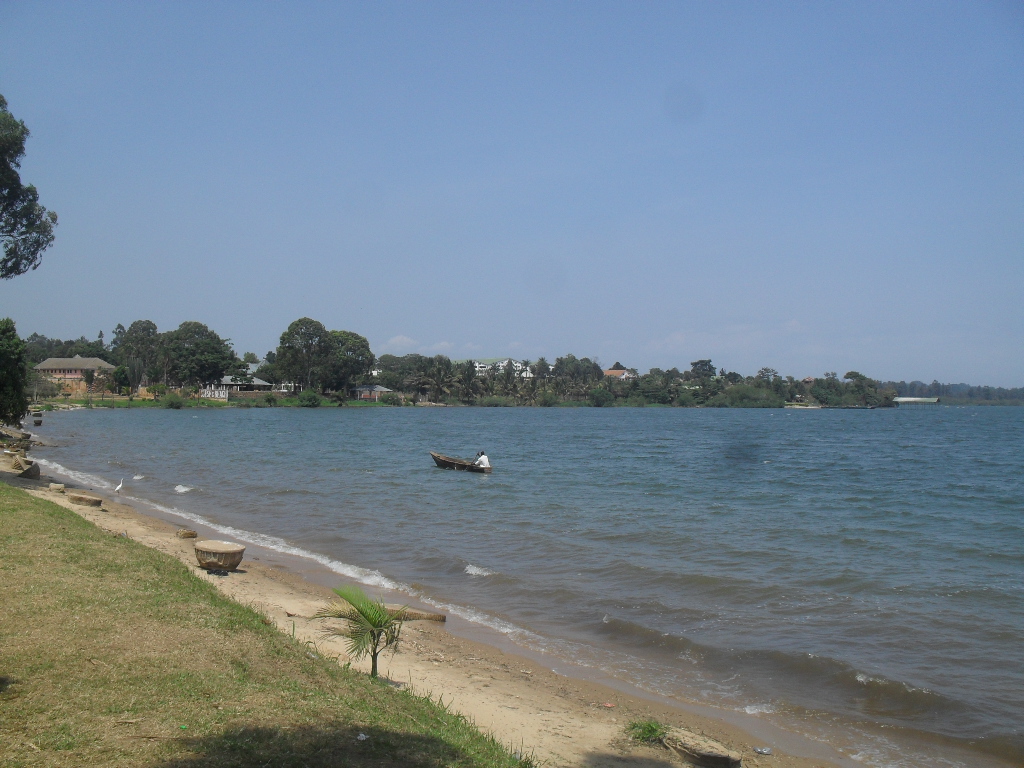 |
| Lake Victoria, or at least a very photogenic small part of it. |
The hills are misty
On the hills of Kampala.
Misty are the hills
Admittedly it’s not the best poetry ever written, but as a matter of self-justification I might add that I had had only two hours sleep over the previous forty-eight hours due to the toddler monstrosity. That night I had little sleep due to the arrival of a tropical storm whose thunder and lightning shook awake even a weary traveller like myself. By the time the morning came, I was exhausted. And subsequently came my long, long, long journey to Soroti.
 |
| It was once said by a great poet, 'The hills are misty/On the hills of Kampala'. Very true. |
Before I came here, I imagined Uganda as a clay-reddish colour, similar to the hills of Zululand (or at least Zululand as presented in the film ‘Zulu’); I imagined lots of dust, where the occasional tree that emerged on the landscape was leafless and dead. With retrospect, I realise that I was imagining Botswana. Uganda, on the other hand, is astonishingly green, so much so that I (like the British imperialists of the 19th Century) cannot help but be reminded of England (even if it is a little hotter than Blighty…). Flowers bloom, trees are resplendent in their garments of leaves, the grass grows thick (the prose is somewhat purple…). The hills around Kampala (the misty ones, in case you forgot) were once considered as being so similar to what the Victorians imagined as ancient Israel that Uganda was genuinely suggested as a future home for European Jews instead of modern Israel.
It was this greenness that first astonished me on my long, long, long journey to Soroti. I even travelled through a rainforest (which the government is trying to cut down so as to build more sugarcane farms). The second astonishment was the roads. Richard, my driver, had warned me that Uganda roads were bad. Nevertheless, for the first three hours, I thought, ‘Nonsense!’ Even when the occasional pothole came up, I thought this was no worse than English country roads.
‘Richard, my dear friend’, said I, ‘I have seen much worse in the nation of India! This is a fine and veritable example of modern engineering I see before my eyes!’
Dear reader, how wrong I was. Soon, I was thrown up-and-down like the Greek economy, shook from left to right like the Labour Party, even at one point hitting my head on the window, like…well, someone hitting their head on something like a window. Potholes in almost every conceivable shape filled the road. Big ones, small ones, some as big as your head. Some were deep enough to lie down in. Most of the time, it was easier to drive on the dirt track on the side of the road than it was to dodge the frequent manifestations of tarmactic guerrilla warfare. Finally, at one point, we were driving simply on dirt track. Or at least, so I thought. For I realised that I was actually driving through one big pothole, with semblances of road still existing. I looked from pothole to road, and from road to pothole, and from pothole to road again; but already it was impossible to say which was which.
 |
| Technically, this is not a dirt track, but an elongated pothole. |
Though the distance between Kampala and Mbale is six times as long as from Mbale to Soroti, the journeying time for both was equal. This, ladies and gentlemen, is why road taxes are actually a good idea. My arrival in Soroti was, to put it mildly, a relief.
Thus ends today’s instalment. Tune in next time for further fun and excitement from the imaginatively named, ‘Ugandan Adventure’. Still yet to come: weddings, funerals, your narrator being overwhelmed by vicious mobs of five-year-old, your narrator being paid homage to as if he were a tribal chief, Germans, starch, goats and much, much more!
Wednesday, 11 September 2013
The Ugandan Adventure
So, first things first: who am I, and why am I writing this blog? I’m Josh Penduck, an ordinand (trainee Anglican priest) at Cranmer Hall in Durham. I’m currently in the Diocese of Soroti in Uganda for a month, on a placement (as part of my training) observing the Anglican Church in this part of the world. I thought a few people might be interested to read some of my experiences…
Second, when I was about to start a blog, I discovered I had already begun a (very) short-lived one several years ago (2009). I had forgotten about it, and I was almost certain that everyone else had forgotten it. Nevertheless, my one-entry blog (a sermon I made several years ago) spread like wildfire through Poland in 2011, with a total of nearly 500 hits. I imagine that many in Poland have been having frequent sleepless nights, awaiting the next instalment of the mighty blog. Now, my Polish friends, I’m happy to say your ceaseless faithfulness has paid its rewards: the blog continues.
So, finally, I have the internet! I bought a dongle after a few days’ delay, and am happily working again ‘on-the-line’. This is the fifth good thing to happen to me today:
1) I had an excellent night’s sleep, the first since I have since I arrived in Uganda last Monday. This is a mixture of jet lag and heat, but I think I’m finally getting the hang of this ‘sleeping’ thing. I had strange dreams, which included me suffering from vertigo in a skyscraper in London, attempting to get a picture of the sunrise; subsequently, I was floating over the city, eating a box of marshmallows. This has improved upon dreams where I accidentally insulted someone’s face and they took me to court, or another dream where I miss my train because my brother decides to start playing the trumpet to my grandfather instead of dropping me off at the station. Ah, malaria tablets! Who needs illegal drugs when I have you to keep me entertained?
2) I had a normally heated shower. After an initial stop in a hotel in Kampala, I have been using the shower in the Guest House in Soroti, next to where Bishop George Ewau (of Soroti Diocese) lives. The Guest House is beautiful, and caters for all my needs. Unfortunately, I first experienced the shower as an onslaught of ice-cold water. The next day, I discovered I needed to turn the heat on. However, this led to the opposite: scaldingly hot water. Finally, after seven days here (who says I lack common sense?) I worked out how to get the shower to be ‘warm’. Naturally, this is an immensely complicated procedure, and no brilliant mind could have worked it out in less time… It would take hours to explain, and doesn’t in any involve turning the heat off for five minutes before I enter…
3) George cooked some excellent toast. Who’s George? He is my housekeeper. [In a sense, having a housekeeper makes me feel like I’m in Downton Abbey, except there’s no white-tie dress code, and so far I am sadly not engaged to Lady Mary]. George fries the toast with the butter already spread, turning this ancient English cuisine into a delightfully hedonistic encounter. Once the Ugandan honey or plum jam is applied, I’m sure it is categorically redefined as a ‘sin’.
4) The fourth thing is something unmentionable in public. A description would involve the consequences of being in contact with unEnglish germs. What is good about this situation is that it has stopped. For the time being.
5) I have internet. This is surprisingly difficult to get (more on that later). Nevertheless, it is got. I came, I searched, I blogged.
So, what have I been up to? In order to find out, you must check out tomorrow’s blog (I’m told short blog entries are the most successful… was this short?). But for a quick taster, the blog over the next few days involves Afro-Pop versions of ‘Here comes the bride’, ten hour funerals, the world’s biggest potholes, walking a pig, and lots and lots of starch!
Second, when I was about to start a blog, I discovered I had already begun a (very) short-lived one several years ago (2009). I had forgotten about it, and I was almost certain that everyone else had forgotten it. Nevertheless, my one-entry blog (a sermon I made several years ago) spread like wildfire through Poland in 2011, with a total of nearly 500 hits. I imagine that many in Poland have been having frequent sleepless nights, awaiting the next instalment of the mighty blog. Now, my Polish friends, I’m happy to say your ceaseless faithfulness has paid its rewards: the blog continues.
So, finally, I have the internet! I bought a dongle after a few days’ delay, and am happily working again ‘on-the-line’. This is the fifth good thing to happen to me today:
1) I had an excellent night’s sleep, the first since I have since I arrived in Uganda last Monday. This is a mixture of jet lag and heat, but I think I’m finally getting the hang of this ‘sleeping’ thing. I had strange dreams, which included me suffering from vertigo in a skyscraper in London, attempting to get a picture of the sunrise; subsequently, I was floating over the city, eating a box of marshmallows. This has improved upon dreams where I accidentally insulted someone’s face and they took me to court, or another dream where I miss my train because my brother decides to start playing the trumpet to my grandfather instead of dropping me off at the station. Ah, malaria tablets! Who needs illegal drugs when I have you to keep me entertained?
2) I had a normally heated shower. After an initial stop in a hotel in Kampala, I have been using the shower in the Guest House in Soroti, next to where Bishop George Ewau (of Soroti Diocese) lives. The Guest House is beautiful, and caters for all my needs. Unfortunately, I first experienced the shower as an onslaught of ice-cold water. The next day, I discovered I needed to turn the heat on. However, this led to the opposite: scaldingly hot water. Finally, after seven days here (who says I lack common sense?) I worked out how to get the shower to be ‘warm’. Naturally, this is an immensely complicated procedure, and no brilliant mind could have worked it out in less time… It would take hours to explain, and doesn’t in any involve turning the heat off for five minutes before I enter…
3) George cooked some excellent toast. Who’s George? He is my housekeeper. [In a sense, having a housekeeper makes me feel like I’m in Downton Abbey, except there’s no white-tie dress code, and so far I am sadly not engaged to Lady Mary]. George fries the toast with the butter already spread, turning this ancient English cuisine into a delightfully hedonistic encounter. Once the Ugandan honey or plum jam is applied, I’m sure it is categorically redefined as a ‘sin’.
4) The fourth thing is something unmentionable in public. A description would involve the consequences of being in contact with unEnglish germs. What is good about this situation is that it has stopped. For the time being.
5) I have internet. This is surprisingly difficult to get (more on that later). Nevertheless, it is got. I came, I searched, I blogged.
So, what have I been up to? In order to find out, you must check out tomorrow’s blog (I’m told short blog entries are the most successful… was this short?). But for a quick taster, the blog over the next few days involves Afro-Pop versions of ‘Here comes the bride’, ten hour funerals, the world’s biggest potholes, walking a pig, and lots and lots of starch!
Subscribe to:
Posts (Atom)