Friday, 13 September 2013

The Ugandan Adventure, Part III: The Ten Hour Funeral

Before I arrived in Uganda, my friend Lucy called me to say that a retired Ugandan bishop had died of a snake bite in his own village. Papa Bishop Geresom Ilukor (Bishops are affectionately named ‘Papa’ in Uganda) was a major figure in both the Ugandan church and Ugandan politics. After his retirement (he was bishop of Soroti from 1976-2000) he advised many minor politicians, and was much respected (even by the Ugandan President). I didn’t realise just how important of a figure he was until I arrived in Soroti.
http://chimpreports.com/index.php/special-reports/crime-investigation/12560-snake-bite-kills-teso-bishop-ilukor.html - a link to a Ugandan newspaper. They've got a picture about 'Papa' Bishop Gereson, with some information


The beginning of the funeral procession
After my long, long, long journey through potholed roads, I rested for a few days in the Guest House in Soroti, before being invited by Bishop George of Soroti Diocese to attend the funeral. And so, on Friday 6th, I awoke early to drive to Kumi where the funeral was being held. Kumi is a smallish town (a little smaller than Soroti), where the hotel toilet has a sign with an unfortunate typo: ‘Please remember to flash after toilet use’. Nevertheless, for a town so small, the turnout to the burial was astonishing. They tell me there were enough chairs for 12,000 people (we all sat in a large square with the bishop’s coffin in the centre). But so many people turned up that they estimated nearly 20,000 present. Amongst these arrivals were bishops, pastors, ministers of government, leaders of universities, business leaders, the chairman of the ruling National Resistance Party, the Prime Minister, the President’s personal representative, and many, many more. After an initial bit of liturgy and song at the beginning of the funeral (three choirs got up to sing traditional African farewells), all of these figures began to give their eulogies.

I can't even begin to show you the size of the event...
In the Church of England, we usually have one or eulogies, in total lasting ten minutes. In Uganda they have… well, I lost count. One eulogy easily lasted an hour. Considering most of it was in Kuman or Etoso, or in very thick Ugandan-English accent, I couldn’t understand most of it. And so I sat and waited. The service started at 9.00am with the arrival of the body. By 10.30am the liturgy had finished, and the eulogies began. Nearly five hours later, at 3.10pm, the Archbishop of Uganda stood up to preach. In the midst of the sweltering sun (thankfully we had canopies above us), I heard perhaps fifty or more eulogies - almost as many speeches at Justin Welby’s leaving service at Durham Cathedral. They even had a doctor’s report for the cause of death. Other than frequently falling asleep, I spent the time noting that the police were walking around selling huge framed pictures of Bishop Geresom, that phones would frequently ring and people would easily have a subsequent conversation (it happened to one speaker mid-eulogy…), and that suddenly the programme would be changed at a moment’s notice.

After the Archbishop’s sermon (which lasted another hour in his thick Lugandan [Kampala region] accent), we all got up and had a feast. Yes, around 20,000 people were suddenly fed. Huge lines of people crisscrossed the field; in about forty minutes, nearly everyone had been given food (and only about ten fights broke out). An astonishing achievement. (It was good quality food as well, even if I had to eat sloppy wet rice with my hands…)
A few of the queues for food

Afterwards, I experienced one of the most humbling moments of my life. I was invited to the house of the bishop’s widow, to mourn with her. I felt unworthy to be there (after all, who am I but essentially a tourist in this country?). For half an hour, maybe an hour, we sat down in the darkening house as a blush red sunset faded over the horizon, its last rays tenderly casting fine lines of red and yellow across the room. The women around the widow, and the dozens gathered outside the house, hypnotically sang a long, hauntingly beautiful dirge, over and over and over again. Occasionally, in the midst of the tragic melody, I would hear a women breaking down in tears outside. After the dirge was finished, there was an intimate silence. After which point Bishop George prayed; we hugged, people cried, we shared the grace. And then, at 7pm, ten hours later, we left.

They don’t do funerals like this back home.


Thursday, 12 September 2013

The Ugandan Adventure: Part II: Haiku and Potholes

It appears that several people enjoyed yesterday’s blog. This is both a good and a bad thing: a good thing in the sense that people are more likely to continue to read the blog; a bad thing in the sense that my most hard-core fans (particularly the Polish die-hards who I imagine have already begun quoting verbatim my posts, and have possibly begun to see how the new blog posts are a continuation - fulfilment even - of the short-lived blog of 2009) will inevitably be disappointed by the following. In a way, I feel like the Obama of blogging. Oblogma, maybe?

I arrived in Entebbe, Uganda last Monday after a long overnight flight stopping in Dubai. For much of the journey I was ferociously kicked in the face as I slept by the South African sleeping next to me. That this brute was only two years old and in no way conscious of what he was doing should in no way take away from the indignity suffered upon me. (The wonders of last-minute-booking.com).

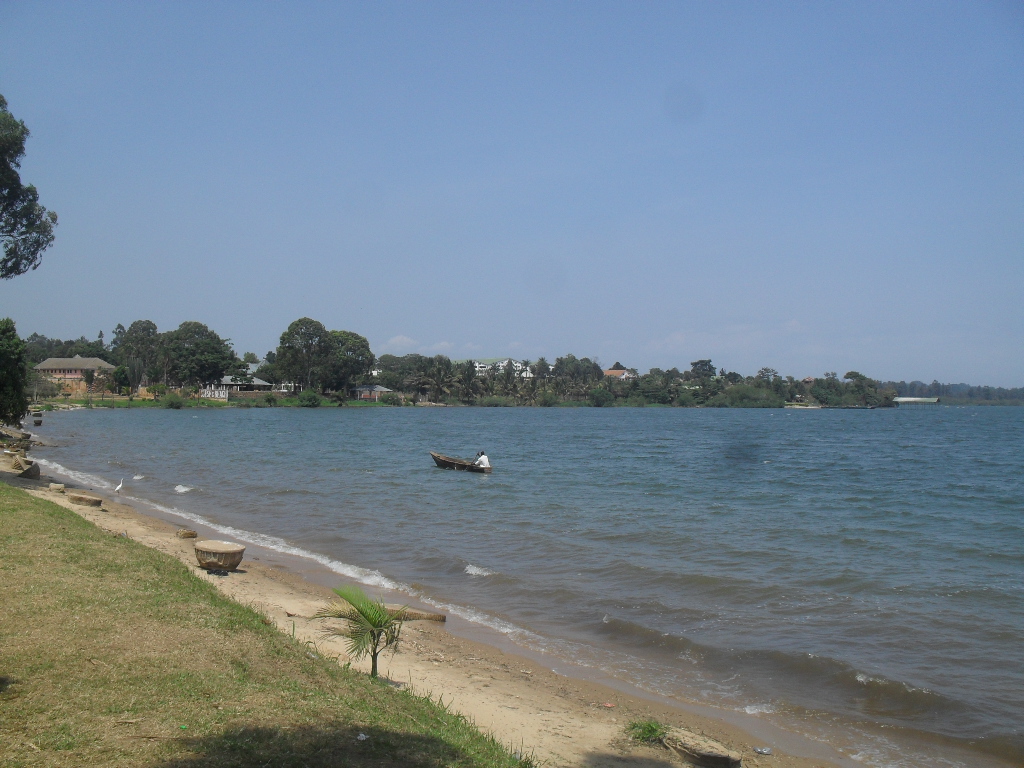
Lake Victoria, or at least a very photogenic small part of it.
After being picked up from the airport by my driver, Richard, I enjoyed the awesome Lake Victoria, before subsequently enjoying the hotel I was staying at (nicknamed ‘a view of a million dollars’). It was an excellent view, though I paid considerably less than a million dollars (more like thirty). For those eager beavers who have been following my every step, you may remember a picture of the mists enveloping the hills of Kampala. I was moved to write a haiku about it:

The hills are misty

On the hills of Kampala.

Misty are the hills

Admittedly it’s not the best poetry ever written, but as a matter of self-justification I might add that I had had only two hours sleep over the previous forty-eight hours due to the toddler monstrosity. That night I had little sleep due to the arrival of a tropical storm whose thunder and lightning shook awake even a weary traveller like myself. By the time the morning came, I was exhausted. And subsequently came my long, long, long journey to Soroti.

It was once said by a great poet, 'The hills are misty/On the
hills of Kampala'. Very true.

Before I came here, I imagined Uganda as a clay-reddish colour, similar to the hills of Zululand (or at least Zululand as presented in the film ‘Zulu’); I imagined lots of dust, where the occasional tree that emerged on the landscape was leafless and dead. With retrospect, I realise that I was imagining Botswana. Uganda, on the other hand, is astonishingly green, so much so that I (like the British imperialists of the 19th Century) cannot help but be reminded of England (even if it is a little hotter than Blighty…). Flowers bloom, trees are resplendent in their garments of leaves, the grass grows thick (the prose is somewhat purple…). The hills around Kampala (the misty ones, in case you forgot) were once considered as being so similar to what the Victorians imagined as ancient Israel that Uganda was genuinely suggested as a future home for European Jews instead of modern Israel.

It was this greenness that first astonished me on my long, long, long journey to Soroti. I even travelled through a rainforest (which the government is trying to cut down so as to build more sugarcane farms). The second astonishment was the roads. Richard, my driver, had warned me that Uganda roads were bad. Nevertheless, for the first three hours, I thought, ‘Nonsense!’ Even when the occasional pothole came up, I thought this was no worse than English country roads.

‘Richard, my dear friend’, said I, ‘I have seen much worse in the nation of India! This is a fine and veritable example of modern engineering I see before my eyes!’

Dear reader, how wrong I was. Soon, I was thrown up-and-down like the Greek economy, shook from left to right like the Labour Party, even at one point hitting my head on the window, like…well, someone hitting their head on something like a window. Potholes in almost every conceivable shape filled the road. Big ones, small ones, some as big as your head. Some were deep enough to lie down in. Most of the time, it was easier to drive on the dirt track on the side of the road than it was to dodge the frequent manifestations of tarmactic guerrilla warfare. Finally, at one point, we were driving simply on dirt track. Or at least, so I thought. For I realised that I was actually driving through one big pothole, with semblances of road still existing. I looked from pothole to road, and from road to pothole, and from pothole to road again; but already it was impossible to say which was which.

Technically, this is not a dirt track, but an elongated pothole.

Though the distance between Kampala and Mbale is six times as long as from Mbale to Soroti, the journeying time for both was equal. This, ladies and gentlemen, is why road taxes are actually a good idea. My arrival in Soroti was, to put it mildly, a relief.

Thus ends today’s instalment. Tune in next time for further fun and excitement from the imaginatively named, ‘Ugandan Adventure’. Still yet to come: weddings, funerals, your narrator being overwhelmed by vicious mobs of five-year-old, your narrator being paid homage to as if he were a tribal chief, Germans, starch, goats and much, much more!


Wednesday, 11 September 2013

The Ugandan Adventure

So, first things first: who am I, and why am I writing this blog? I’m Josh Penduck, an ordinand (trainee Anglican priest) at Cranmer Hall in Durham. I’m currently in the Diocese of Soroti in Uganda for a month, on a placement (as part of my training) observing the Anglican Church in this part of the world. I thought a few people might be interested to read some of my experiences…

Second, when I was about to start a blog, I discovered I had already begun a (very) short-lived one several years ago (2009). I had forgotten about it, and I was almost certain that everyone else had forgotten it. Nevertheless, my one-entry blog (a sermon I made several years ago) spread like wildfire through Poland in 2011, with a total of nearly 500 hits. I imagine that many in Poland have been having frequent sleepless nights, awaiting the next instalment of the mighty blog. Now, my Polish friends, I’m happy to say your ceaseless faithfulness has paid its rewards: the blog continues.

So, finally, I have the internet! I bought a dongle after a few days’ delay, and am happily working again ‘on-the-line’. This is the fifth good thing to happen to me today:

1) I had an excellent night’s sleep, the first since I have since I arrived in Uganda last Monday. This is a mixture of jet lag and heat, but I think I’m finally getting the hang of this ‘sleeping’ thing. I had strange dreams, which included me suffering from vertigo in a skyscraper in London, attempting to get a picture of the sunrise; subsequently, I was floating over the city, eating a box of marshmallows. This has improved upon dreams where I accidentally insulted someone’s face and they took me to court, or another dream where I miss my train because my brother decides to start playing the trumpet to my grandfather instead of dropping me off at the station. Ah, malaria tablets! Who needs illegal drugs when I have you to keep me entertained?

2) I had a normally heated shower. After an initial stop in a hotel in Kampala, I have been using the shower in the Guest House in Soroti, next to where Bishop George Ewau (of Soroti Diocese) lives. The Guest House is beautiful, and caters for all my needs. Unfortunately, I first experienced the shower as an onslaught of ice-cold water. The next day, I discovered I needed to turn the heat on. However, this led to the opposite: scaldingly hot water. Finally, after seven days here (who says I lack common sense?) I worked out how to get the shower to be ‘warm’. Naturally, this is an immensely complicated procedure, and no brilliant mind could have worked it out in less time… It would take hours to explain, and doesn’t in any involve turning the heat off for five minutes before I enter…

3) George cooked some excellent toast. Who’s George? He is my housekeeper. [In a sense, having a housekeeper makes me feel like I’m in Downton Abbey, except there’s no white-tie dress code, and so far I am sadly not engaged to Lady Mary]. George fries the toast with the butter already spread, turning this ancient English cuisine into a delightfully hedonistic encounter. Once the Ugandan honey or plum jam is applied, I’m sure it is categorically redefined as a ‘sin’.

4) The fourth thing is something unmentionable in public. A description would involve the consequences of being in contact with unEnglish germs. What is good about this situation is that it has stopped. For the time being.

5) I have internet. This is surprisingly difficult to get (more on that later). Nevertheless, it is got. I came, I searched, I blogged.

So, what have I been up to? In order to find out, you must check out tomorrow’s blog (I’m told short blog entries are the most successful… was this short?). But for a quick taster, the blog over the next few days involves Afro-Pop versions of ‘Here comes the bride’, ten hour funerals, the world’s biggest potholes, walking a pig, and lots and lots of starch!

Saturday, 12 December 2009

Hope at Christmas

Let me be honest with you: I really, really hate picking up the newpapers at times. Perhaps I was in a good mood beforehand, but after a quick reading, I find that my pleasantries have been twisted into anger, rage, depression, bitterness - above all, hopelessness. Just a brief glance through any national newspaper, news website or magazine, and you will find a deep, deep, deep well of agonized pessimism towards the future. What ever you're passionate about - or even have a light interest in - it seems that hope is gone. At this Christmas time, it seems we've entered a much darker and depressing world than one perhaps, say, five years ago - whether that is because of international recession, joblessness, government cuts, or inequality in life; or perhaps we have a claustrophobic fear that the country - or the world - that we love so much is being replaced by something 'other'. Maybe we have a fear of crime and street gangs, or of immigration, or of extremism and terrorism, or of the increasing indifference that people have to God and morals, or of the apocalyptic descriptions people give to climate change or nuclear war.

If the papers are to be believed, within ten years we'll somehow be living in the bewildering paradox of a secular and atheistic bureaucratic dictatorship which is run by Islamic extremists, which believes in complete and utter moral freedom and depravity whilst at the same time being infuriatingly puritanical, whilst losing all economic competitiveness against the rising economies of the east, whilst facing global flooding, the annihilation of the human race by war, disease or climate change, which is meaningless anyway because the human race will eventually go extinct, the earth will be swallowed up by an exploding sun, the universe will either collapse or expand so far that it becomes a cold, empty and dark place of useless existence.

Sounds fun.

Woody Allen expresses this feeling well when he says,

'Life is full of misery, loneliness and suffering and it's all over much too soon.'

The thing is, this fatalistic attitude to life may sell well, but it isn't necessarily true. Take, for example, the situation of the nation of Judea in the First Century AD. Here we have a nation that used to be powerful, rich and respected, but by the time of the Christmas story, everything has changed: at that time, the country was occupied by a brutal, vicious and uncaring foreign empire called Rome, which would do the most heinous and shocking crimes against humanity in the name of the misnamed 'pax Romana' - Roman peace; there is a corrupt, sadistic and perverted dictator installed on the Jewish throne infamously known as King Herod; there is also a religious elite that could not care less about the spiritual and emotional needs of the average person, and the only religious people who do have a sense of moral integrity - the Pharisees - are so severe at times that any chance of 'living' is utterly sapped away; there are prophecies that had been given in the ancient past about a saviour whom God would send, but every day this promise seemed ever less likely; some of the religious elites - in the form of the Sadducees, even said that God had no interest in human affairs (at least according to the historian Josephus). The world of 1st Century Judea was politically, morally, religiously and economically corrupt and - above all - hopeless. In the end, most people did little more than simply exist.

So far, this seems to be turning out to be an incredibly depressing thought. It seems to be about a world without hope in the past, and now hopeless in the present. And yet we now look upon that ancient time as a moment of supreme joy; we celebrate it with songs, poems, gifts, bright lights and wrapping paper, decorated trees, Handel's Messiah and the best films on television. That period in the past where hope seemed dead is now - bizarrely - seen by children as the most wonderful day of the year; for adults it is a time where - hopefully - we can relax after the year's strains, with a cup of hot mulled wine or even just a cup of tea. Christmas time is a festival about joy; but how could such a festival - celebrated across the whole of the world - come out of such a joyless, hopeless situation in 1st Century Judea?

We all know the reason: it's about the birth of a child in a small town of Bethlehem. Yet even that story in itself could be seen as hopeless:

Here we have a pregnant teenager called Mary;

Here we have a child whose father was not Mary's fiance;

Here we have an unnecessary and dangerous trek across the unforgiving landscape of the Middle East;

Here we have a situation where a child cannot even be born inside a house, but instead inside a filthy cave meant for the animals, not people;

Here we have a government so oppresive and sadistic that it would be willing to kill baby children out of paranoid fear.

But we don't celebrate Christmas for that - after all, does that deserve being celebrated? Instead, we celebrate the birth of a special child, and unnusual child, a remarkable child. Through some mystery inconcievable through human intellect, the ultimate reality, the ground of all existence - the being, which as St. Paul writes, 'we live and move and have our being' - was 'made flesh' in the birth of Jesus Christ. And for two thousand years, we've been celebrating His birthday. Now that's some remarkable child!

That child was light in a world of darkness.
That child was love in a loveless age.
That child was true joy in a world fundamentally joyless.
That child brought healing where sickness thrived.
That child brought meaning where life seemed meaningless.
That child brought peace where violence reigned.
That child gave value to unvalued people.
That child gave compassion to those who society hated.
That child gave friendship to those who were isolated.
That child is hope where hope seems to die.

December is the most depressing time of the year: it is the time where the days are shorter, the nights are longer, the hours are colder, and the minutes seem to be more loveless. It is a time of insecurity, fear and pressure. For many, Christmas is still the most depressing 24 hours on the calendar.

And yet, through Jesus Christ, we have hope. Real substantial hope. Though it is quiet - almost silence - it stirs. You can hear it in the soft whispers Mary and Joseph spoke in love towards their child. You can hear it in those wailing tears that the child Jesus first cried out into the world. You can hear it in the penniless adoration of the shepherds, and the generous giving of the wise men.

Wherever there is darkness, fear, silence and indifference, there is also hope. That is why we sing this carol:

'O little town of Bethlehem,
How still we see thee lie!
Above thy deep and dreamless sleep
The silent stars go by.
Yet...in thy dark streets shineth
The everlasting Light;
The hopes and fears of all the years
Are met in thee tonight.'